Book Club: Part Five
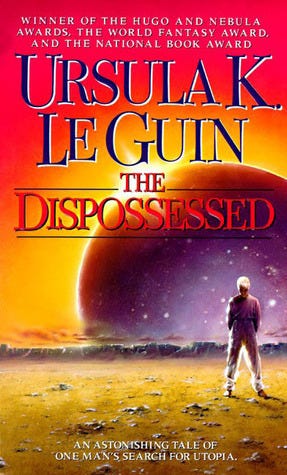
The Dispossessed by Ursula K. Le Guin

“You cannot buy the revolution. You cannot make the revolution. You can only be the revolution. It is in your spirit, or it is nowhere.”
― Ursula K. Le Guin, The Dispossessed: An Ambiguous Utopia
Bookclub theme: FREESTYLE
Book suggested by: Jess
Rating: average of 4/5★★★★
Aimee: 4/5★★★★Ciara: 4/5★★★★Jesse: 4.5/5★★★★Marianne: 4/5★★★★Rebecca: 4.5/5★★★★Jess: 4/5★★★★As a genre writer myself, I was incredibly excited when Jess suggested The Dispossessed as her choice for book club. Ursula K. Le Guin is a towering name in the science fiction community, and yet, I had never read any of her novels. I own her poetry collection So Far, So Good, which is phenomenal, but for some reason I had never made it around to her fiction. Fundamentally, she has altered science fiction in a way only she could, and she deserves every ounce of credit for that. This book is not the best match for my personal tastes, but it was impossible to deny her talent. As the book explores some large political ideologies and theoretical knowledge, I found there to be an emotional coldness to The Dispossessed that will either be its greatest strength or its greatest weakness, depending on the reader. For me, it was difficult to hold on to.
I often find that genre fiction is often flattened into plot, reduced to what happens rather than how it is built. That isn’t necessarily a bad thing, as plot is incredibly important, but it is rare to find structure this intentional. Last book club, when we read The Dream Hotel, I talked about craft and how genuine craft in a book is hard to find—by which I mean structure, layout, and authors thinking about their work as a whole object to be experienced, not just a sequence of events. The Dispossessed is a perfect example of that kind of craft. The structure is organized around time, mirroring what the protagonist, Shevek, is studying, and it is fascinating to watch Le Guin construct a novel this deliberately. Her world building is monumental. The form of the book is not decorative, it is the argument. The cyclical nature almost demands a reread, its structure echoing the ideological cycles it discusses. This is not a book about a better world. It is a book about how a world can break. I wasn’t sure what to think when I started the book, Le Guin herself having subtitled the book “an ambiguous utopia.” There are always many ideas and arguments to unpack when dealing with utopias, but I was interested to find that The Dispossessed is less interested in imagining perfection and more interested in examining its erosion.
We all had things we loved and things we struggled with, but none of us could rate it lower than a four. Even when the content was not our favourite, it was impossible to deny that this is a work of art.
Summary.
“It is our suffering that brings us together. It is not love. Love does not obey the mind, and turns to hate when forced. The bond that binds us is beyond choice. We are brothers. We are brothers in what we share. In pain, which each of us must suffer alone, in hunger, in poverty, in hope, we know our brotherhood. We know it, because we have had to learn it. We know that there is no help for us but from one another, that no hand will save us if we do not reach out our hand. And the hand that you reach out is empty, as mine is. You have nothing. You possess nothing. You own nothing. You are free. All you have is what you are, and what you give.”
― Ursula K. Le Guin, The Dispossessed: An Ambiguous Utopia
The Dispossessed is an anarchist utopian science fiction novel that follows Shevek, a theoretical physicist from Anarres, a moon settled by revolutionaries who rejected centralized power and hierarchy. Though founded on ideals of freedom and willing cooperation, Anarres has become deeply isolated, cut off from its lush Mother planet, Urras, and from the wider universe. As Shevek works on a radical theory of time, he begins to question not only the limits of physics, but the limits his society has placed on thought and change.
When Shevek crosses the divide between the two worlds, the novel examines how different political systems shape ideas of freedom, abundance, and responsibility. Moving between past and present, Anarres and Urras, The Dispossessed treats time itself as something non-linear, mirroring the separation between people, planets, and ideologies. Rather than offering a perfect utopia, the novel asks what it means to live ethically in an imperfect world, and whether true freedom is possible.
Background.
The Dispossessed, first published as The Dispossessed: An Ambiguous Utopia, is a landmark anarchist utopian science fiction novel by Ursula K. Le Guin. First published in 1974, it stands among her most acclaimed works, and is often counted as part of the loosely connected Hainish Cycle, a set of stories exploring different human societies across distant worlds. The novel won the Nebula Award, the Hugo Award, and the Locus Award for Best Novel, a rare trifecta in speculative fiction, and helped cement Le Guin’s reputation as a writer who blended imaginative world building with poignant ethical debates.
“You can’t crush ideas by suppressing them. You can only crush them by ignoring them. By refusing to think, refusing to change.”
― Ursula K. Le Guin, The Dispossessed: An Ambiguous Utopia
Ursula Kroeber Le Guin (1929-2018) was one of the most influential and honoured authors in science fiction and fantasy. With over more than five decades of work (23 novels, 12 volumes of short stories, 11 volumes of poetry, 13 children’s books, five essay collections, and four works of translation) she won numerous awards, and received lifetime recognition for her contributions to literature. Her books—such as The Left Hand of Darkness and Earthsea—are known for their rich cultural imagination and nuanced examinations of society, identity, and power structures, which helped push speculative fiction as a genre into a broader cultural conversation about these topics.
Thoughts.
Through reading this book, I discovered that while I tout that I love fantasy, science fiction, horror and the likes, I actually don’t like science fiction that much. Or I do, but it has to be very specific science fiction. I don’t tend to love classic or hard science fiction, a space opera isn’t usually what I go for (with exceptions), nor do I love interstellar politics and battle empires. I prefer science fiction that is grounded in human experience, more concerned with people than technology, and that uses speculative elements as a way to explore alienation, identity, and the quieter consequences of scientific or societal change. I find science fiction is often much too zoomed out as it is exploring multiple new worlds and governments and endless possibilities. I prefer books that are more zoomed in, focused on something small to explain the larger whole. Which is ironic, because I think you could argue that The Dispossessed does that. Except, with our protagonist being a physicist, the book truly embodies the science of it all and that is where I sadly lose interest. What can I say? I am a poetics girl, not a technical girl.
“There’s a point, around the age of twenty, when you have to choose whether to be like everybody else the rest of your life, or to make a virtue of your peculiarities.”
― Ursula K. Le Guin, The Dispossessed: An Ambiguous Utopia
While I’ve started off this review by declaring that I didn’t love this book, I want to get into a more nuanced discussion of it. I didn’t love it as a whole, but I think there are such excellent parts of this book and I am incredibly glad I read it. The book gives you a lot to chew on, and truly offers multiple perspectives in a way that I don’t think is positing one as better than the other. Just because this is a book about anarchists, Le Guin is not dismantling capitalism in favour of utopia. She is dismantling the idea that any system stays pure and can be absent of guilt, which is much more interesting. How do you protect a revolution once its been won?
The world building in this book is phenomenal. It feels fully realized, with strong descriptions. Simply reading about Shevek moving through the day is honestly one of the best parts. My favourite aspect of the novel though, is its structure. The chapters alternate between past and present, mirroring the way Shevek understands and studies time itself, which feels like an excellent piece of craft.
“The thing about working with time, instead of against it, he thought, is that it is not wasted. Even pain counts.”
― Ursula K. Le Guin, The Dispossessed: An Ambiguous Utopia
That said, the science did not land for me. Because Shevek’s theory is so abstract and theoretical, it is difficult to find footing: we all agreed there is very little tangible application to hold onto. While there are many wonderful human moments and deeply philosophical passages, the science itself becomes hard to grasp precisely because it cannot be meaningfully applied. It suffers from being too smart, so far removed from the reader’s understanding that it feels impossible to engage with without sounding foolish. There is a clear nod to Nietzsche’s idea of eternal recurrence (a blast back to my university days), but even that operates more as concept than practice. And I don’t mind suspending disbelief when it comes to science, I generally don’t understand it anyways, but it has to be pivotal. Jesse brought up the good point that the book often felt less like science fiction and more like political theory, since the physics matters less than the question of what anarchism looks like when it is given free reign. The novel could arguably function without the physics of it all and still have the same message. Shevek acts as a vessel for knowledge, but the circulation of knowledge is far more important than the knowledge itself.
“To be whole is to be part; true voyage is return.”
― Ursula K. LeGuin, The Dispossessed: An Ambiguous Utopia
What is most compelling is how Le Guin depicts anarchism as both an ideal and a lived reality, and then shows how it degrades over time. She illustrates how ideology calcifies, and how control re-emerges in subtle and informal ways. This was most fascinating to me and I think the word calcify does sum it up best. There is always room for guilt and social expectation in any ideology, no matter how hard you try to remove it, and to watch how an ideology can harden over time and chip away at itself is so interesting in a way I didn’t realize I was looking for.
Overall, we found the book to be fascinating, though the science felt unnecessarily complicated and the ending somewhat too neat. Without blatant spoilers, for a novel critical of capitalism, it is strange that the resolution seems to suggest an easy escape as a solution.
“To make a thief, make an owner; to create crime, create laws.”
― Ursula K. Le Guin, The Dispossessed: An Ambiguous Utopia
None of us had previously read a book so openly critical of collectivism, as there is often a reluctance to admit its flaws, as though doing so would mean abandoning the idea altogether. It is a wonderful example of a wonderful debate. Le Guin is being critical of all sides and is showing examples and outcomes to ponder. None of which feel entirely desirable at the moment. And yet, the ideas linger. The anarchists follow a figure named Odo, who argues that one must exist in a kind of hell in order to imagine something new—that utopia has to be conceived in prison, because it is impossible to dream another system while fully embedded in capitalism. I don’t know about you, but that feels especially resonant now.
“If you evade suffering you also evade the chance of joy. Pleasure you may get, or pleasures, but you will not be fulfilled. You will not know what it is to come home.”
― Ursula K. Le Guin, The Dispossessed: An Ambiguous Utopia
This will never be a favourite of mine, largely because there was little for me to personally connect to. Shevek is an arrogant man; self righteous and often unwilling to recognize his own faults, I found him hard to relate to. So character aside, I turn to plot, but so much of the plot is scientific in theory and language. Not a lot to hold on to for little ol’ me. My opinion aside, I found this character well suited for the topic of this novel as Le Guin’s analysis becomes critical rather than cynical which is refreshing. With the anarchist planet running out of resources, solidarity is their greatest strength, but that solidarity exists largely because of their shared suffering. An eternal cycle to debate and critique. Even though I had a hard time resonating with most of the novel’s content, I think it has some excellent quotes that definitely resonate with the world we are experiencing today.
“The individual cannot bargain with the State. The State recognizes no coinage but power: and it issues the coins itself.”
― Ursula K. Le Guin, The Dispossessed: An Ambiguous Utopia
An ambiguous utopia feels like the right description, and ambiguous is an excellent way to describe how I feel about this book.
Our next book: The Summer Book by Tove Jansson
Thanks for reading <3
xx,
Ciara
Bibliography:
Jonathan Bolton, “To Touch the Dust of Anarres,” Los Angeles Review of Book. https://lareviewofbooks.org/article/to-touch-the-dust-of-anarres/
Alison Flood, “Hugo Award: Ursula Le Guin,” The Guardian, March 29, 2011. https://www.theguardian.com/books/booksblog/2011/mar/29/hugo-award-ursula-le-guin
Nusantara Naga, “The Man from the Moon: A Review of Ursula K. Le Guin’s The Dispossessed,” A Naga of the Nusantara, October 19, 2019. https://nusantaranaga.wordpress.com/2019/10/19/the-man-from-the-moon-a-review-of-ursula-k-le-guins-the-dispossessed/
“The Dispossessed,” Ursula K. Le Guin Official Website. https://www.ursulakleguin.com/dispossessed
hey I also read The Dispossessed recently so naturally I ran to substack to see what's up. loved this post and wanted to share some of my thoughts as well :)
1. Honestly the world-building didn't land with me 100%, I get that a novel with this ambition can't dwell any one place too long, but the circular timing which meant we were constantly going between Urras and Andarres just highlighted how much each felt like concepts designed to highlight the strength in the other rather than living, breathing places in and of themselves. So as concepts they work great! As places I just didn't feel it.
2. None of the characters were all that great to me except Vea. Love Vea. Wanted to like Shevek but his cavalier idealism to bring Urras and Andarres together seemed contradictory to his more immanent periods where he just listens to everyone around him and works on his theories. And of course, our protagonist is allowed to have both of those sides to him. But they do not come into tension enough for me to find him believable, Shevek does quite feel like the character he ought to be if that makes sense.
3. I agree that those sci-fi descriptions of science just felt like fluff. There was something cool and metaphysical in the idea of promise that was being gestured at, how when one keeps a promise they in effect extend their present-self's power and put a bind on a future-self's power, bringing time together. But that also kind of just floated among the themes for me.
Anyway, it was still very thought-provoking, and I enjoyed reading it most of the time. I'd give it 3.5/5 if I had to rate it. Great piece
wonderful